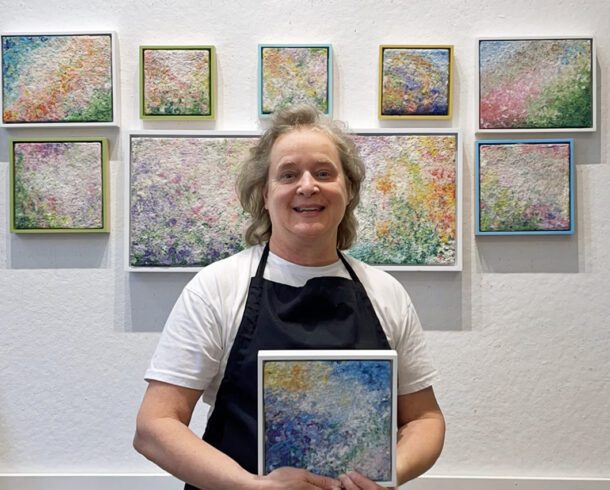
Jul 24, 2011 | Pulp painting
Wow, does this look ugly! The under layer of a handmade paper isn’t much to write home about.Here, the basic composition is being planned out.Note the grids that separate each section of the painting.I use red china marker for the larger squares (the painting is 40 x...
Jul 22, 2011 | Pulp painting
figure 1 This blog explains the process I use to create my handmade paper paintings. In this case, the painting I will create is of a seascape which will be included in an upcoming exhibit at Cove Gallery on Cape Cod. Using cotton and abaca (a fiber from...
Jan 5, 2010 | Pulp painting
Valley Fiber Life, an on-line magazine for fiber arts has published an article about my pulp painting process. The article may be accessed by visiting their web site and clicking on “Articles and Interviews” and then clicking on “Paper/Book Arts”....
Dec 31, 2009 | Pulp painting
Another view of the painting surface with newly applied overbeaten abaca on the surface. www.megblack.com www.megblackprints.com
Dec 31, 2009 | Pulp painting
Overbeaten abaca refers to a fiber harvested from the inner bark of the banana tree, that has been beaten for approximately 20 hours. Abaca is a gorgeous fiber, ivory in color, that will not disintegrate when wet, which is why abaca is used to make tea bags. I...
Dec 17, 2009 | Pulp painting
The painting is laid flat on the vacuum table. Small cups of pigmented overbeaten abaca are set on top of the base painting ready to be applied to the surface. These colors will become the “paint” for the painting. I have gridded the surface so that I...