About the commission:
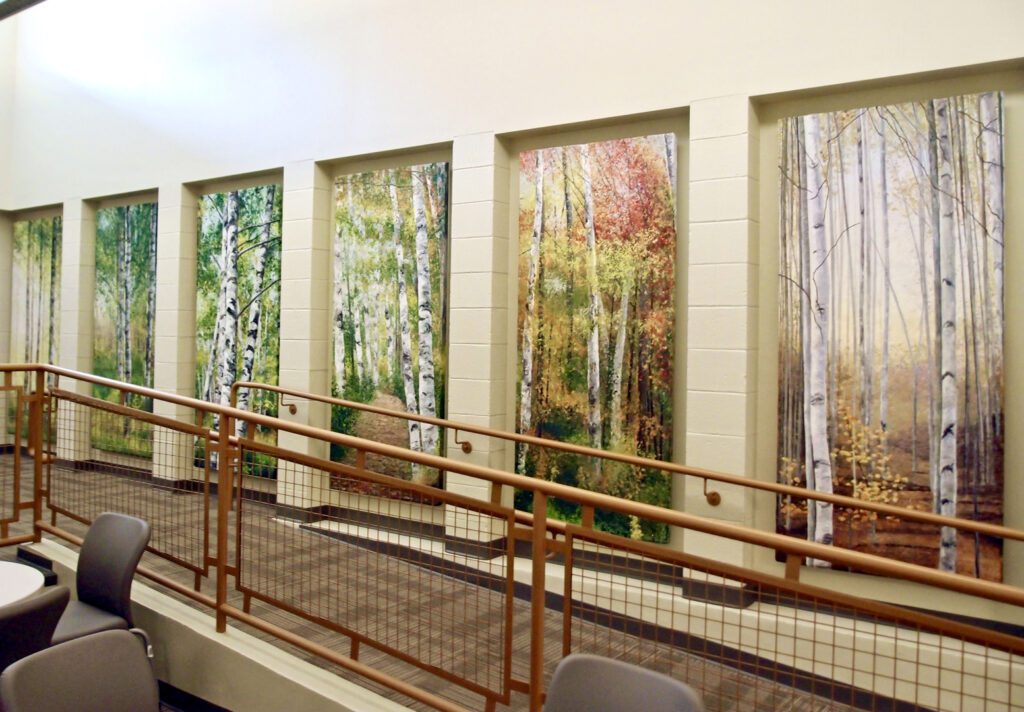
I chose the theme of Transitions for my proposal for six 37.5 x 85 x 2 inch paintings that were recently installed on the wall extending along the ramp of the Anna Philbrook Center, Concord, New Hampshire. By transitions I was referring to the building itself, the people who use the building, and the transitional colors and shapes of the New Hampshire landscape.
Transitions refers to the changes the building has undergone both physically and with regard to the many services it has provided for its users over the years. From its original purpose as a State Hospital with a focus on the psychiatric needs of children, to its current role of assisting New Hampshire residents in securing licenses in a variety of professions, the building has seen many changes over the years. The people who use the building, especially those who are applying for a professional license after years of study and apprenticeship, are themselves experiencing an erstwhile transition as they enter this new and exciting phase of their lives.
Transitions also refers to the New Hampshire landscape. I focused on the New Hampshire State Tree, the white birch, as it appears from the dawn of spring to late autumn, from morning shimmer to afternoon twilight. The first panel represents the tree as it appears in early morning in springtime; the final panel represent the tree as it appears in late autumn during the afternoon. The panels in between illustrate transitions between these two extremes. These transitions found in nature metaphorically mimic those experienced between the building and its users.
The medium: the paintings are made of natural fibers such as abaca (an exceptionally strong fiber imported from the Philippines used to make carpet, marine cordage and clothing), hemp and linen, pure non-fading pigments that are guaranteed to be light fast, and museum quality glue and sizing (to make the surface waterproof).
The paintings are lightweight but extremely strong-they are guaranteed not bend, break, tear or fade for as long as they are installed in their intended location. Each panel will be mounted onto a 37.5 x 85 x 4 inch frame. The frame were constructed out of 2 x 4’s and faced with a ¼ sheet of acid free MDF board that has been coated with latex as a sealant. The frames have a French Cleat built into the top for mounting/dismounting purposes..
What inspired the compositon:
When I was asked, “what influences your art?” I knew the person asking the question really meant “what other artists influence your art?”, or “what subjects influence your art?”. While these variables have certainly influenced me, as I have progressed as an artist, I find myself increasingly influenced by concepts, or, more specifically, by philosophical traits introduced by previous cultures. One such concept is symmetria, introduced by the Greeks and defined as “a dynamic balance of imbalances, such as straight vs. bent, left vs. right, one complimentary color offset by another and so on.
The Greeks used symmetria in most of their major works, including the vase painting of Achilles and Ajax playing checkers by Exekias. In this painting we see the two mythical warriors concentrating on their game; Achilles with his hat on, his shield at his back, has sword leaning against the board that acts as a table. Ajax, his hat off, his shield leaning against a tree and his shield at his side, provides an imbalance to Achilles that instead of mirroring his competitor’s gait provides a level of imbalance that mimics the tension they undoubtedly feel as they compete in their game
I have incorporated the idea of symmetria in the six paintings of the birch trees by attempting to imbalance the trees in the left paintings with those on the right; the trees in the first paintings lean to the right, their leaves fall onto the right side of the composition. By contrast, the trees in the last painting lean leftwards; their leaves and branches dominating the left side.
Attempting to mimic the Greek use of symmetria with these paintings has proven challenging. I have found myself referring to Exekias’ vase repeatedly and marveling over the genius of this ancient art.
The paintings are in the State of New Hampshire public collection.